
Three species of invasive iguana have established breeding populations in Florida. All three are classified as Conditional/Prohibited/Nonnative Species by the Florida Fish and Wildlife Conservation Commission. This guide helps homeowners, HOA managers, parks staff, and school facility teams identify each species, understand the lifecycle, recognize seasonal behavior patterns, and tell iguanas apart from the native lizards that belong in the Florida landscape.
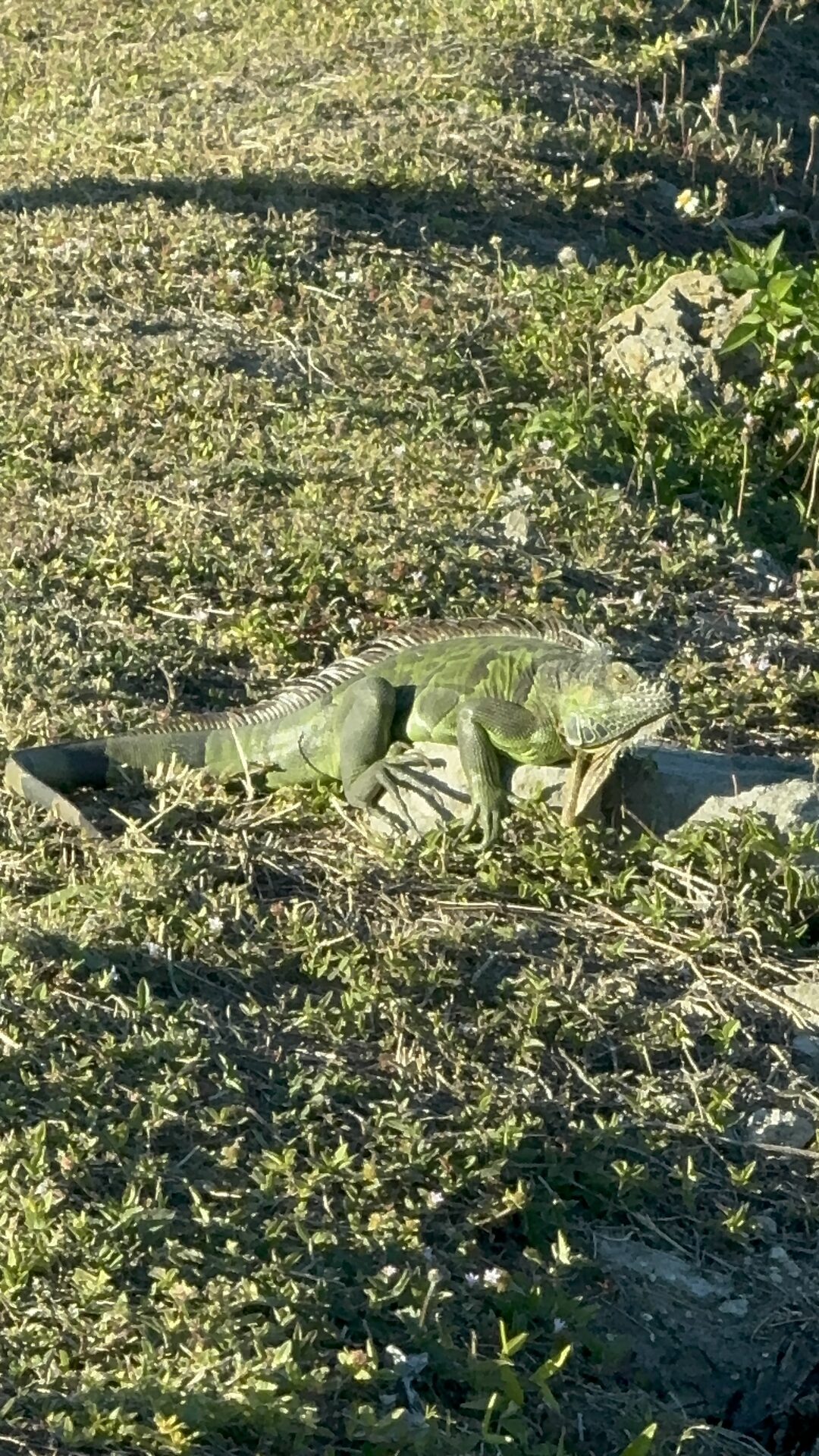
Adult green iguana captured during a removal job in Naples, Florida.
Why Identification Matters
Correct identification is the first step in any responsible wildlife management plan. Native Florida lizards are protected by state law and should be left alone. Invasive iguanas, by contrast, are destructive to property and infrastructure, and Florida law allows their humane removal by permitted professionals. Misidentifying a native lizard as an iguana can lead to unnecessary harm to a protected species, while failing to identify an invasive iguana early can lead to burrow damage, seawall collapse, and thousands of dollars in repairs.
If you are unsure what species you are looking at, do not handle the animal. Take a clear photo, note the location, and contact a licensed wildlife management professional. Rocky's offers free property inspections throughout Southwest Florida, including Naples, Fort Myers, Bonita Springs, Estero, Port Royal, Sanibel, and Captiva.
1. Green Iguana (Iguana iguana)
The green iguana is the most common and most destructive invasive iguana in Southwest Florida. Originally from Central and South America, green iguanas arrived in Florida through the pet trade and have since established large, self-sustaining populations across the southern part of the state.
How to Identify a Green Iguana
- Size: Adults can reach 5 feet in total length including the tail. Males are typically larger than females. The tail alone can make up more than half the total body length.
- Color: Juveniles are bright green, which is how the species gets its name. Adults range from green to gray-green to brown. Dominant males develop bright orange coloration on the head, jowls, and dewlap during the breeding season, which in Southwest Florida runs roughly from October through March. The orange coloring is not present year-round and is the most reliable visual cue that you are looking at an adult male in breeding condition.
- Dewlap: A large, pendulous flap of skin hangs beneath the chin. The dewlap is used for thermoregulation and territorial display. Males display the dewlap prominently when asserting dominance or courting. Females have a smaller dewlap.
- Dorsal spines: A row of pointed spines runs along the center of the back from the neck to the base of the tail. These spines are stiff and are one of the easiest features to see from a distance. No common native Florida lizard has this row of dorsal spines.
- Tail: The tail is long, thick at the base, and heavily banded with dark rings. It can be used as a whip-like weapon when the animal is threatened. The tail also breaks off when grabbed by a predator, and the iguana can regrow it over time, though a regrown tail is usually darker and less symmetrical.
- Jowl: Adult males develop large, rounded jowls (cheeks) that give the head a swollen, boxy appearance. This is especially visible during breeding season.
- Eyes: Green iguanas have a distinctive white or pale scale at the rear corner of each eye, which helps reflect the identification from photographs.
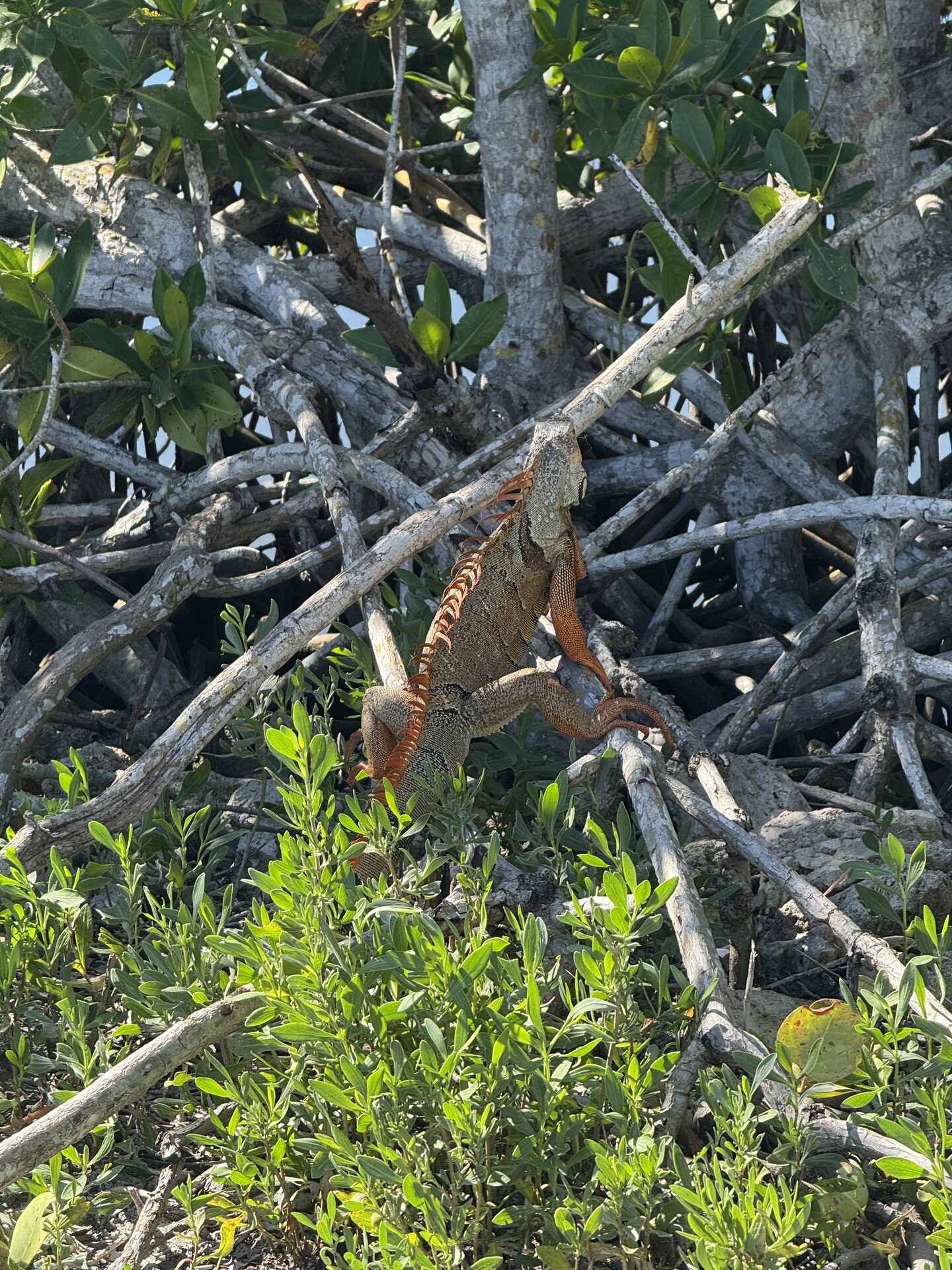
An adult male green iguana displaying orange breeding coloration in a tree. The orange hue appears during mating season and fades afterward.
Behavior
Green iguanas are primarily herbivorous, eating leaves, flowers, and fruit. They are excellent swimmers and are commonly found near canals, ponds, lakes, and seawalls. They dig burrows for shelter and nesting, and these burrows are the source of most structural damage to seawalls, foundations, and canal banks. Green iguanas are diurnal, meaning they are active during the day and bask in the sun on docks, seawalls, and tree branches.
During cold snaps, green iguanas can enter a state of torpor called brumation. Their body temperature drops, they become sluggish, and in some cases they fall from trees. This is not death; the iguana typically recovers as temperatures rise. If you see a large, motionless iguana on the ground after a cold night, do not assume it is dead or harmless. It can become active quickly once it warms up.
2. Mexican Spiny-Tailed Iguana (Ctenosaura pectinata)
The Mexican spiny-tailed iguana is smaller than the green iguana but is still a significant invasive species in parts of Southwest Florida, particularly in areas around Naples and Marco Island. Like the green iguana, it arrived through the pet trade and has established localized breeding populations.
How to Identify a Mexican Spiny-Tailed Iguana
- Size: Adults reach approximately 18 to 36 inches in total length, making them noticeably smaller than green iguanas. The tail is roughly equal to the body length in proportion.
- Color: Color varies widely. Adults are often a mix of gray, brown, and olive, sometimes with dark crossbands on the body and tail. Some individuals show yellow or orange tones on the sides. Juveniles are usually green, which can cause confusion with juvenile green iguanas.
- Dorsal spines: A prominent crest of spines runs along the back and continues down the tail. The spines on the tail are distinctive and give the species its common name. This tail crest is more pronounced and more continuous than in green iguanas.
- Build: The body is more compact and muscular than the green iguana, with a chunkier, less streamlined appearance. The head is shorter and broader.
- Whip-like tail: The tail is heavily ringed with whorls of spiny scales. It is used as a defensive weapon and will break off when grabbed.
Behavior
Mexican spiny-tailed iguanas are more agile and faster than green iguanas. They are excellent climbers and are often found in trees, on walls, and around rock piles. They dig burrows in rocky soil, under concrete slabs, and in retaining walls. They are omnivorous, eating both plant matter and insects, which makes them more adaptable than the strictly herbivorous green iguana. They are more likely to flee quickly when approached, which makes them harder to capture without professional equipment.
3. Black Spiny-Tailed Iguana (Ctenosaura similis)
The black spiny-tailed iguana is the largest of the spiny-tailed species and has established populations in parts of South Florida. It is less common than the green iguana in Southwest Florida but has been documented in the region and its range appears to be expanding.
How to Identify a Black Spiny-Tailed Iguana
- Size: Adults can reach 4 feet in total length, making them nearly as large as green iguanas. Males are larger than females.
- Color: Adults are typically dark gray to nearly black, with lighter gray or tan crossbands across the back. The dark overall coloration is the easiest distinguishing feature from the other two species. Juveniles are green or olive and can be confused with juvenile green iguanas.
- Dorsal spines: A long, continuous crest of spines runs from the neck down the back and along the tail. The tail spines are particularly large and form distinct whorls.
- Build: Stocky and muscular, similar to the Mexican spiny-tailed iguana but larger and darker.
- Head: The head is large and blocky with a pronounced jowl in adult males.
Behavior
Black spiny-tailed iguanas are the fastest lizards in the Americas, capable of sprinting at speeds over 20 miles per hour. They are highly territorial and aggressive when cornered. They dig extensive burrow systems and can cause the same types of structural damage as green iguanas. They are omnivorous, eating fruit, leaves, insects, and small vertebrates. Their adaptability and speed make them a difficult species to manage without professional help.
Iguanas vs. Native Florida Lizards
Florida is home to many native lizard species, including anoles, skinks, and glass lizards. Most native lizards are small (under 12 inches), do not have dorsal spines, and do not dig burrows large enough to damage structures. The table below summarizes the key differences between invasive iguanas and common native Florida lizards.
| Feature | Green Iguana | Mexican Spiny-Tailed | Black Spiny-Tailed | Native Florida Lizards |
|---|---|---|---|---|
| Maximum length | Up to 5 feet | 18 to 36 inches | Up to 4 feet | Usually under 12 inches (a few reach 18 inches) |
| Dorsal spines | Yes, prominent row along back | Yes, along back and tail | Yes, along back and tail | No dorsal spine crest |
| Typical color | Green to gray-green; orange in breeding males | Gray, brown, olive with crossbands | Dark gray to black with tan crossbands | Varies: green, brown, gray, often with dewlap display |
| Dewlap | Large, prominent | Small or absent | Small or absent | Present in anoles but much smaller |
| Tail | Long, banded, whip-like | Ringed with spiny whorls | Ringed with spiny whorls, thick | Slender, may break off (autotomy), not spiny |
| Burrowing | Deep burrows up to 6 ft deep, 80 ft long | Shallow burrows under rocks and slabs | Extensive burrow systems | Generally do not dig damaging burrows |
| Swimming | Excellent swimmer, near water | Can swim, prefers dry ground | Can swim, prefers dry ground | Some species swim, most do not |
| Diet | Herbivorous (leaves, flowers, fruit) | Omnivorous (plants and insects) | Omnivorous (plants, insects, small animals) | Mostly insectivorous |
| Legal status in FL | Invasive, may be humanely removed with FWC permit | Invasive, may be humanely removed with FWC permit | Invasive, may be humanely removed with FWC permit | Native, protected, do not remove |
| Structural damage risk | High: burrows undermine seawalls and foundations | Moderate: burrows under slabs and walls | High: extensive burrow systems | None |
The simplest rule: if the lizard is longer than 18 inches and has a visible row of spines along its back or tail, it is almost certainly an invasive iguana. If it is smaller than 12 inches, has no dorsal spines, and is displaying a small dewlap (as anoles do), it is a native lizard and should be left alone.
Iguana Lifecycle in Southwest Florida
Understanding the iguana lifecycle helps property owners time inspections and removal efforts. Green iguanas in South Florida follow a predictable seasonal cycle driven by temperature and rainfall. Each stage below represents a different size, behavior pattern, and level of property risk.
Egg
Females dig nesting burrows in sandy soil, often near seawalls or canal banks. Eggs incubate for 10 to 15 weeks depending on soil temperature.
Hatchling
Hatchlings emerge bright green and independent. They are vulnerable to predators but grow fast. Most mortality occurs in this stage.
Juvenile
Juveniles are still green but growing. They begin establishing territory near their hatching burrow and start feeding on landscaping plants.
Adult
Adults are sexually mature. Males turn orange in breeding season. Females dig nesting burrows. Adults can live 8 to 10 years in the wild.
A single female green iguana can lay 30 to 70 eggs per clutch, and in South Florida some females produce more than one clutch per year. Without removal, a small population on a property can grow to dozens of animals within two to three nesting seasons. This is why early intervention is far less expensive than waiting until burrow damage becomes structural.
Seasonal Behavior Chart: What Iguanas Do Each Season in SWFL
Iguana behavior in Southwest Florida follows a predictable seasonal pattern. Property owners and HOA managers can use this chart to time inspections, anticipate burrow activity, and plan removal efforts before damage escalates.
| Season | Months | Behavior | Property Risk |
|---|---|---|---|
| Breeding Season | October to March | Males turn orange, display dewlaps, fight for territory. Increased activity and visibility during the day. | Moderate to High: territorial males dig and defend burrows. Seawall and canal bank burrowing increases. |
| Nesting Season | April to August | Females dig nesting burrows in sandy soil, often near seawalls, canal banks, and landscape beds. Each clutch has 30 to 70 eggs. | Highest: nesting burrows are the primary source of structural damage. Burrows can go 6 feet deep and 80 feet long. |
| Hatching Season | June to October | Hatchlings emerge from nesting burrows. Bright green, 8 to 10 inches long, fast-moving. Begin feeding on plants immediately. | Rising: new animals entering the population. Landscaping damage increases as hatchlings begin feeding. |
| Cold Weather (Brumation) | December to February (variable) | During cold snaps, iguanas enter torpor. They may fall from trees and appear dead. They recover as temperatures rise. | Low activity, but burrows are still present. Do not assume a cold-stunned iguana is harmless. |
| Warm Season (Peak Activity) | March to November | Peak feeding and basking. Iguanas are most visible on seawalls, docks, and in trees. Landscaping damage is most severe. | High: active feeding destroys landscaping. Burrow systems are in use and expanding. |
Rocky's field team during an iguana removal job in Southwest Florida.
What to Do If You Spot an Iguana
If you see an iguana on your property, the most important thing is to act early. A single iguana can become a breeding population within one nesting season. Follow these steps:
Take a Photo and Note the Location
Photograph the iguana from a safe distance. Note the date, time, and where on the property you saw it. This helps a professional confirm the species and plan the removal.
Do Not Feed It
Feeding iguanas teaches them that your property is a food source. Even leaving fallen fruit or unsecured garbage can attract them. Remove food sources immediately.
Do Not Handle It
Iguanas can bite, scratch, and use their tails as weapons. Their droppings carry salmonella. Leave capture to a licensed, insured, FWC-permitted professional.
Call a Professional
Call Rocky's at (239) 922-5992 for a free property inspection. We confirm the species, identify burrows, and build a removal and prevention plan that is humane and Florida-compliant.
Report Invasive Iguana Sightings
You can report invasive iguana sightings to the Florida Fish and Wildlife Conservation Commission through the IveGot1 reporting system (online at IveGot1.org or by calling 888-IVE-GOT1). Reporting helps the state track the spread of invasive populations. However, reporting does not remove the animal from your property. For actual removal and burrow remediation, you need a licensed, FWC-permitted wildlife management professional.
About Rocky's Cane Toad and Iguana Management
Rocky's is a Naples-based wildlife management company specializing in humane iguana removal, iguana burrow remediation, and cane toad management. We hold a Conditional/Prohibited/Nonnative Species Permit from the Florida Fish and Wildlife Conservation Commission, and we are fully licensed and insured. We serve Naples, Fort Myers, Bonita Springs, Estero, Port Royal, Sanibel, and Captiva. Free property inspections are available. Call (239) 922-5992 or request an inspection online.