
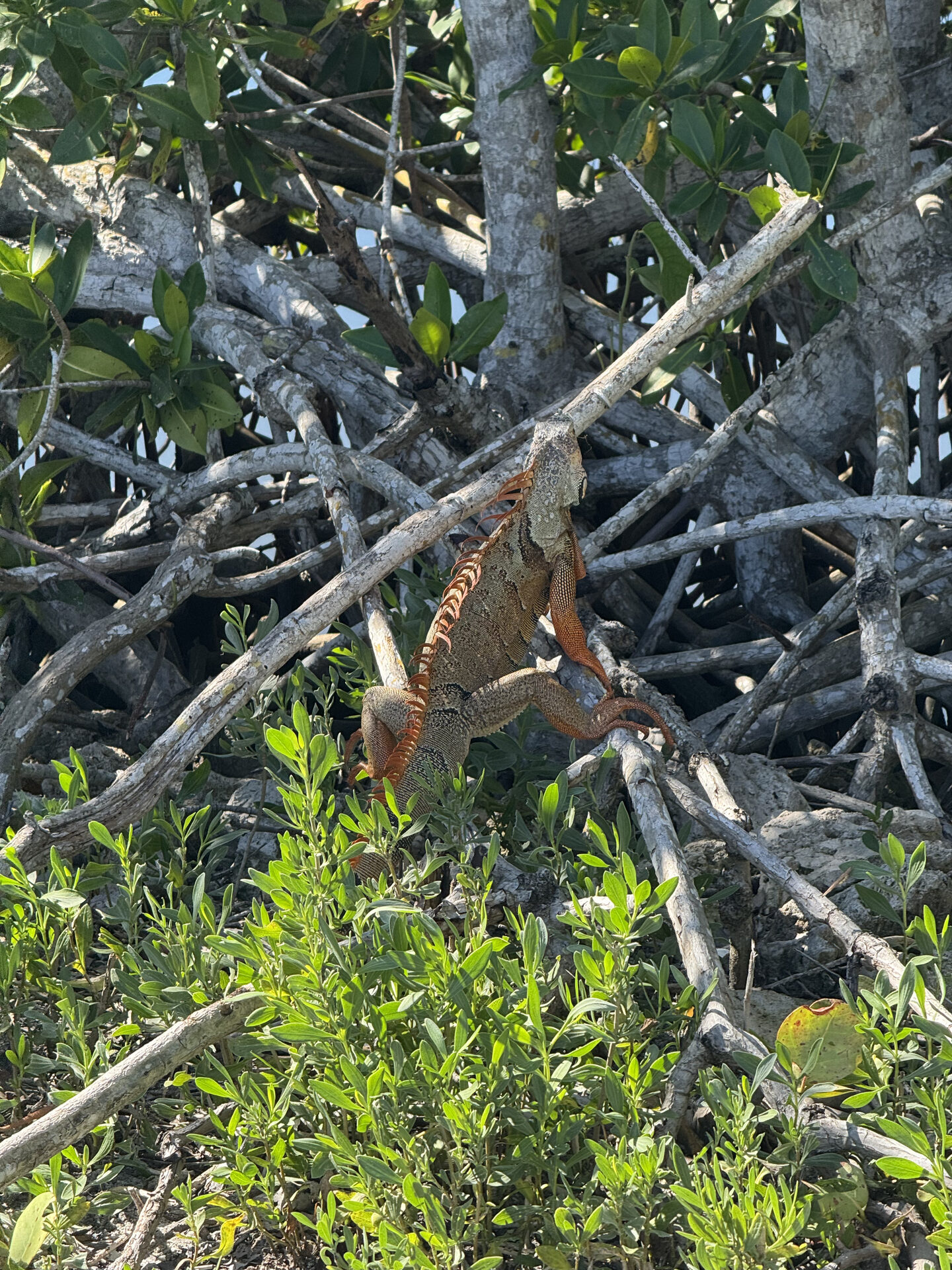
Every winter in Naples, the same story makes the rounds on local news and social media: iguanas falling out of trees. It sounds like an urban legend, but it is real. And while it may seem like a joke, the phenomenon tells you something important about iguana behavior and what it means for removal on your property.
Yes, Iguanas Really Do Freeze and Fall
It is not a myth. When temperatures drop below 50 degrees, green iguanas become sluggish or completely immobile. Their blood literally slows down. As cold-blooded reptiles, iguanas cannot regulate their own body temperature. They depend on the environment for warmth. When the air gets cold enough, their muscles stop working properly and they lose their grip on branches.
The result is exactly what the headlines describe. Iguanas that were basking in trees lose their grip and fall to the ground. They may appear dead, but in many cases they are simply immobilized by the cold.
This Is Called Brumation
The correct term for this is brumation. Brumation is the reptile equivalent of hibernation. When temperatures drop, iguanas enter a state of reduced metabolic activity. Their heart rate slows, their breathing slows, and they become largely motionless. This is a survival mechanism that allows them to endure cold periods.
Here is the key point: iguanas do not necessarily die from the cold. Many of the iguanas that fall from trees during a cold snap will wake up and become active again when temperatures rise. A cold snap is not a natural extermination event. The iguana population does not crash just because the temperature dropped for a few days.
Does This Mean Iguanas Go Away in Winter?
No. This is one of the most dangerous misconceptions about iguanas in Southwest Florida. Homeowners sometimes assume that winter cold snaps will take care of the iguana problem for them. They will not.
During cold snaps, iguanas retreat to their burrows. A burrow that goes 6 feet deep and 80 feet long stays well above ambient air temperature underground. The iguana rides out the cold in the burrow and emerges when the weather warms. On mild winter days, when the sun is out and the temperature is comfortable, iguanas come out to bask. They are still on your property, they are still active on warm days, and the burrow system is still intact underground.
Southwest Florida winters are mild. Cold snaps that drop temperatures below 50 degrees are typically short-lived, lasting a day or two before warming back up. The iguana population does not decrease from cold weather in our region. The animals simply slow down temporarily and then resume normal activity.
What This Means for Removal
The freezing phenomenon has practical implications for how and when to remove iguanas.
Cold Snaps and Burrow Remediation
Cold snaps are actually a good time for burrow remediation. When temperatures drop, iguanas are concentrated in their burrows. This makes it easier to identify active burrows and address them. If you have been putting off burrow remediation, a cold snap is a reminder that the burrows are still there, still occupied, and still causing damage underground even when the iguanas are not visible above ground.
Active Season Is Still the Best Time for Removal
While cold snaps concentrate iguanas in burrows, removal is most effective during the active season. Iguanas are diurnal, meaning they are active during the day. From April through October, during nesting season, iguanas are out and visible. They bask on seawalls, docks, and rooftops. They feed on landscaping. They are easier to spot, catch, and remove. This is the window when weekly suppression is most effective.
During nesting season, which runs April through October, females lay 30 to 70 eggs per clutch. Removing breeding females before they lay eggs prevents the next generation from hatching and maturing on your property. Mating season peaks in April and May, and hatching runs June through October with a 90-day incubation period. The active season is when the population grows, and it is when removal has the greatest impact.
How to Protect Your Property Year-Round
The lesson from the freezing iguana phenomenon is simple: do not wait for cold snaps to solve your iguana problem. Cold weather does not eliminate iguanas from your property. It only sends them underground, where the burrows continue to cause damage.
Year-round protection means:
- Regular suppression during active season: Weekly visits from April through October to remove iguanas before the population grows.
- Burrow checks year-round: Burrows are active in winter too. Checking and remediating burrows during colder months prevents the underground damage from continuing unseen.
- Nesting season sweeps: Focused removal during nesting season to prevent eggs from being laid and hatched.
Burrow damage does not take a winter break. The void under your seawall, foundation, or pool pad is still there, and it is still getting worse. The only way to stop it is professional excavation and backfill, done before the structural damage becomes irreversible.
Schedule a Free Inspection
Whether it is January or July, if you have iguanas on your property, the time to act is now. Rocky's Cane Toad and Iguana Management offers free property inspections year-round. We will assess your property, identify active burrows, and recommend a removal and remediation plan. We serve Naples, Fort Myers, Cape Coral, Bonita Springs, Estero, Port Royal, Sanibel, and Captiva. Call (239) 922-5992 to schedule your free inspection. Same-day response and 24/7 emergency service available.