
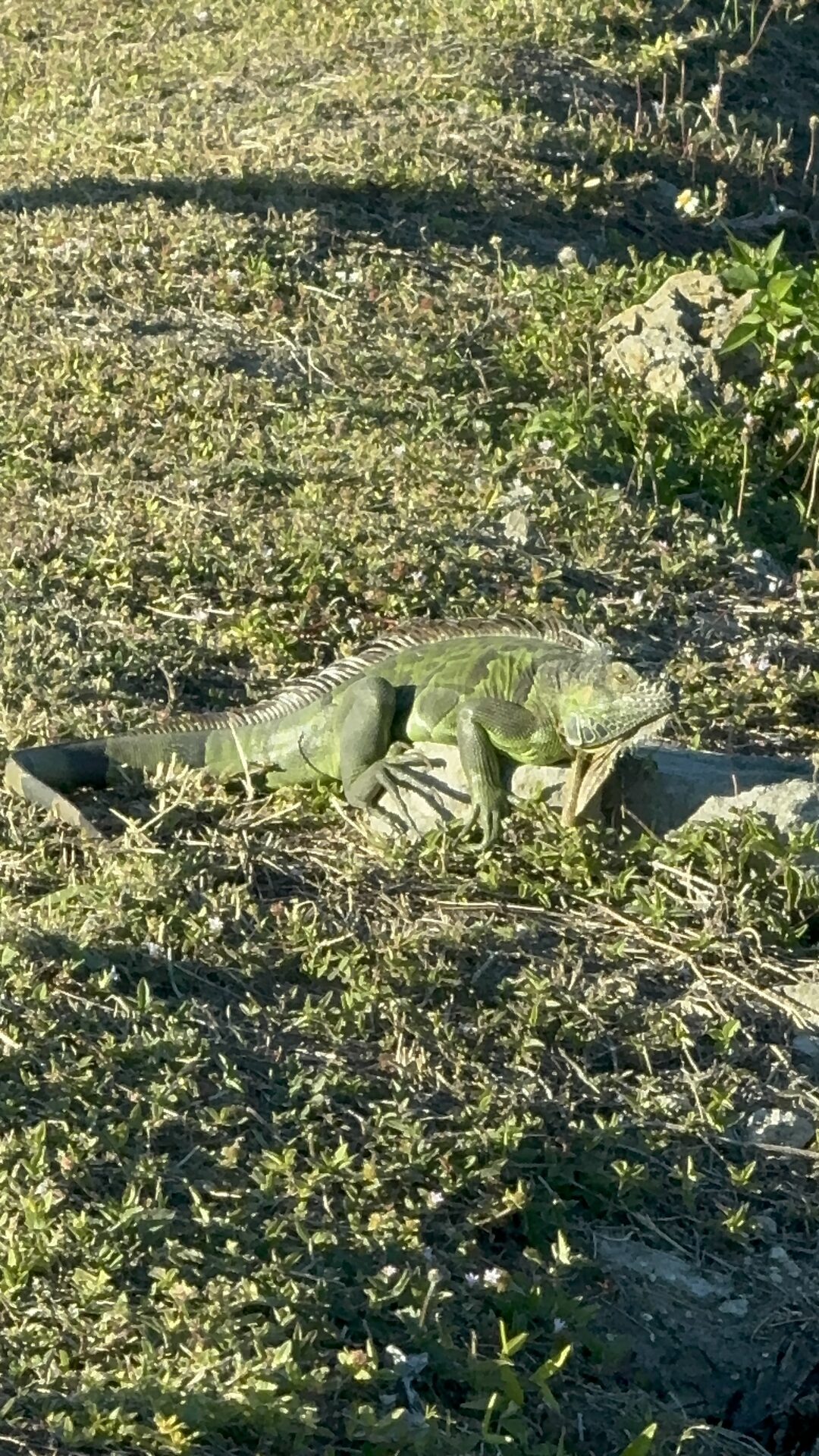
Not every lizard in your yard is a problem. Florida has dozens of native lizard species that are harmless and even beneficial. But green iguanas are invasive, destructive, and require professional removal. Knowing the difference helps you know when to call and when to leave the lizard alone.
Green Iguanas: The Invasive Problem
Green iguanas are large, herbivorous lizards native to Central and South America. They were introduced to Florida through the pet trade and have established breeding populations throughout South Florida. They are classified as an invasive species by the FWC.
Key identifying features:
- Size: Adults can reach 5 feet in length including the tail. This is the easiest way to distinguish them from native lizards.
- Color: Typically green, but males can display bright orange coloring during mating season. Juveniles are bright green.
- Dewlap: A large flap of skin under the chin that they extend for communication and temperature regulation.
- Dorsal spines: A row of spines running down the back from neck to tail.
- Powerful tail: The tail is longer than the body and can deliver a painful slap.
- Behavior: Often seen basking in the sun on seawalls, docks, rooftops, and tree branches. They are diurnal (active during the day).
- Burrowing: They dig burrows 6 feet deep and 80 feet long. Native Florida lizards do not dig burrows of this scale.
Native Florida Lizards: Leave Them Alone
Several native lizard species are commonly seen in Southwest Florida yards. None of them cause the property damage that iguanas do.
- Brown anole: Small (5-8 inches), brown, often seen on fences and walls. Introduced but not invasive in the same destructive way as iguanas.
- Green anole: Small (5-8 inches), can change from green to brown. Native to Florida. Harmless and beneficial for insect control.
- Southeastern five-lined skink: Small (5-8 inches), glossy with stripes. Lives in leaf litter. Harmless.
- Eastern fence lizard: Small (4-7 inches), rough scales, gray or brown. Harmless.
- Florida scrub lizard: Small (5-6 inches), gray with dark stripes. Native and harmless.
The Key Differences
If the lizard in your yard is under 10 inches long, it is almost certainly not an iguana. Green iguanas are dramatically larger than any native Florida lizard. A juvenile iguana may be smaller, but it will still have the distinctive dewlap, dorsal spines, and green coloring.
The other major difference is burrowing. If you find a hole 6 to 12 inches in diameter near your seawall, foundation, or pool equipment, it is an iguana burrow. Native lizards do not dig burrows of that size.
Other Invasive Lizards in Southwest Florida
Two other invasive iguana species have been documented in Southwest Florida:
- Mexican spiny-tailed iguana: Darker coloration, spiny tail, smaller than green iguana but still large (2-4 feet). Documented in Cape Coral and Fort Myers.
- Black spiny-tailed iguana: Dark gray to black, very aggressive, fast runner. Found in some coastal areas.
Both of these species are also invasive and should be removed by a professional.
When to Call for Removal
If you see a lizard that is 2 feet or longer, has a dewlap and dorsal spines, or is digging burrows on your property, it is an iguana. Call Rocky's for professional, FWC-permitted removal. We serve Naples, Fort Myers, Cape Coral, Bonita Springs, Estero, Port Royal, Sanibel, and Captiva. Free property inspections. Call (239) 922-5992 or visit iguanaswfl.com.