
Green iguanas are not native to Florida. They were first documented in the Miami area in the early 1960s, and releases of pets over the following decades helped them spread. Today they are established across much of central and southern Florida, most commonly near the coast, along canals, and in suburban and urban landscapes.
Property managers and homeowners across Naples, Fort Myers, Bonita Springs, and Estero ask the same question: how fast can an iguana population grow? This article walks through what published research says about egg numbers, hatching, survival, and sex, then shows what those numbers add up to over five years.
Key Takeaways
- A mature female typically lays one clutch per year, with published clutch sizes ranging from about 10 to 70 eggs. A figure near 40 is a reasonable planning number.
- In Florida, nesting runs roughly December through April, and hatchlings appear in summer.
- Sex is set genetically, so roughly half of hatchlings are expected to be female.
- Most eggs and hatchlings never reach adulthood, but the ones that do start laying as early as age two. That is what makes growth compound.
- In a simple five-year model, one female and her descendants can account for roughly 1,800 eggs at 20% survival, and several thousand at higher survival rates possible on golf courses and in HOA communities.
How Many Eggs Does a Female Iguana Lay?
UF/IFAS Extension reports that green iguanas lay approximately 10 to 70 eggs in a nest burrow. A Florida Museum of Natural History herpetologist gives the same 10 to 70 range per adult per year. Other published ranges for the species run slightly wider, about 14 to 76 eggs per clutch.
Clutch size depends on the female's size, nutrition, and maturity, so larger, well-fed females lay more. A commonly cited typical clutch is around 40 eggs, and one Florida study documented a single clutch of 41. For the projections in this article, we use 40 eggs per mature female per year.
Females dig nest burrows about a foot deep and up to three feet long, usually in sunny, well-drained soil. They do not guard the nest after laying.
When Does Nesting Happen in Florida?
UF/IFAS places the Florida breeding season between December and April. Eggs incubate for roughly two to four months depending on temperature, with hatchlings emerging during the summer. Hatchlings are about 7 inches long excluding the tail.
When Do Iguanas Start Breeding?
A study in southern Florida found that males can reach sexual maturity as early as 16 months and females as early as 24 months. Across the species, females are generally reported to mature between two and four years of age. In the wild they can live 15 to 20 years where predators and competitors are absent.
The model below assumes daughters begin laying two years after hatching, which matches the earliest documented maturity in Florida.
How Are Males and Females Determined?
Green iguanas have an XX/XY sex chromosome system, confirmed by a 2020 genomic study. Because sex is determined genetically at fertilization, incubation temperature does not flip eggs between male and female the way it does in sea turtles. The expected ratio at hatching is about 50% female.
Individual clutches can skew either way by chance, and adult sex ratios observed in the field vary by site. One Colombian study reported about 2.5 females per male among adults, which the authors attributed to the species' mating system rather than a true imbalance at birth.
How Many Eggs Actually Hatch?
Published hatching figures vary widely, and no Florida-specific egg-level hatch rate turned up in the sources reviewed for this article.
- Captive green iguanas, Oaxaca, Mexico: A six-year study of 137 females found an average clutch of 23.5 eggs and hatching success of 64.8%.
- Captive green iguanas, Indonesia: One thesis recorded only 24% of 173 eggs hatching, with losses attributed to fungal infection during incubation.
- Wild green iguanas, Colombia: Nests suffered little vertebrate predation but were damaged by flooding, cattle trampling, and fly larvae.
A reasonable working figure for green iguanas is about 65% of eggs hatching, with a realistic range of roughly 25% to 95% depending on flooding, predators, and incubation conditions.
How Many Survive to Breeding Age?
This is the least certain number in the whole picture. No published Florida-specific estimate of survival from egg to adulthood was found. The closest evidence comes from related studies:
- A summary of Dr. Dagmar Werner's work in Central America reports that about 95% of wild green iguanas are lost to predators in their first two years, which implies survival to age two near 5%.
- Among Andros Island rock iguanas, a close relative, survival of newly released hatchlings to 28 days ranged from about 17% to 28%.
- In Florida, UF/IFAS notes that adults have few predators other than humans, while eggs and very young iguanas are the ones at risk. Raccoons and gray foxes are documented egg predators.
Because the real number depends so heavily on local conditions, the projections below show several survival scenarios instead of a single answer.
What Happens Over Five Years: A Simple Model
To show how quickly the numbers compound, we modeled one mature female and her descendants over five years with these assumptions:
- Each laying female produces 40 eggs per year.
- Half of surviving offspring are female.
- Daughters begin laying two years after hatching, so females hatched in year 1 lay for the first time in year 3.
- The original female lays every year for all five years.
- "Survival" means the share of eggs that reach age two.
Year-by-Year Results at 20% Survival
| Year | Females Laying | Eggs Laid | Survivors to Age 2 | Of Those, Female |
|---|---|---|---|---|
| 1 | 1 | 40 | 8 | 4 |
| 2 | 1 | 40 | 8 | 4 |
| 3 | 5 | 200 | 40 | 20 |
| 4 | 9 | 360 | 72 | 36 |
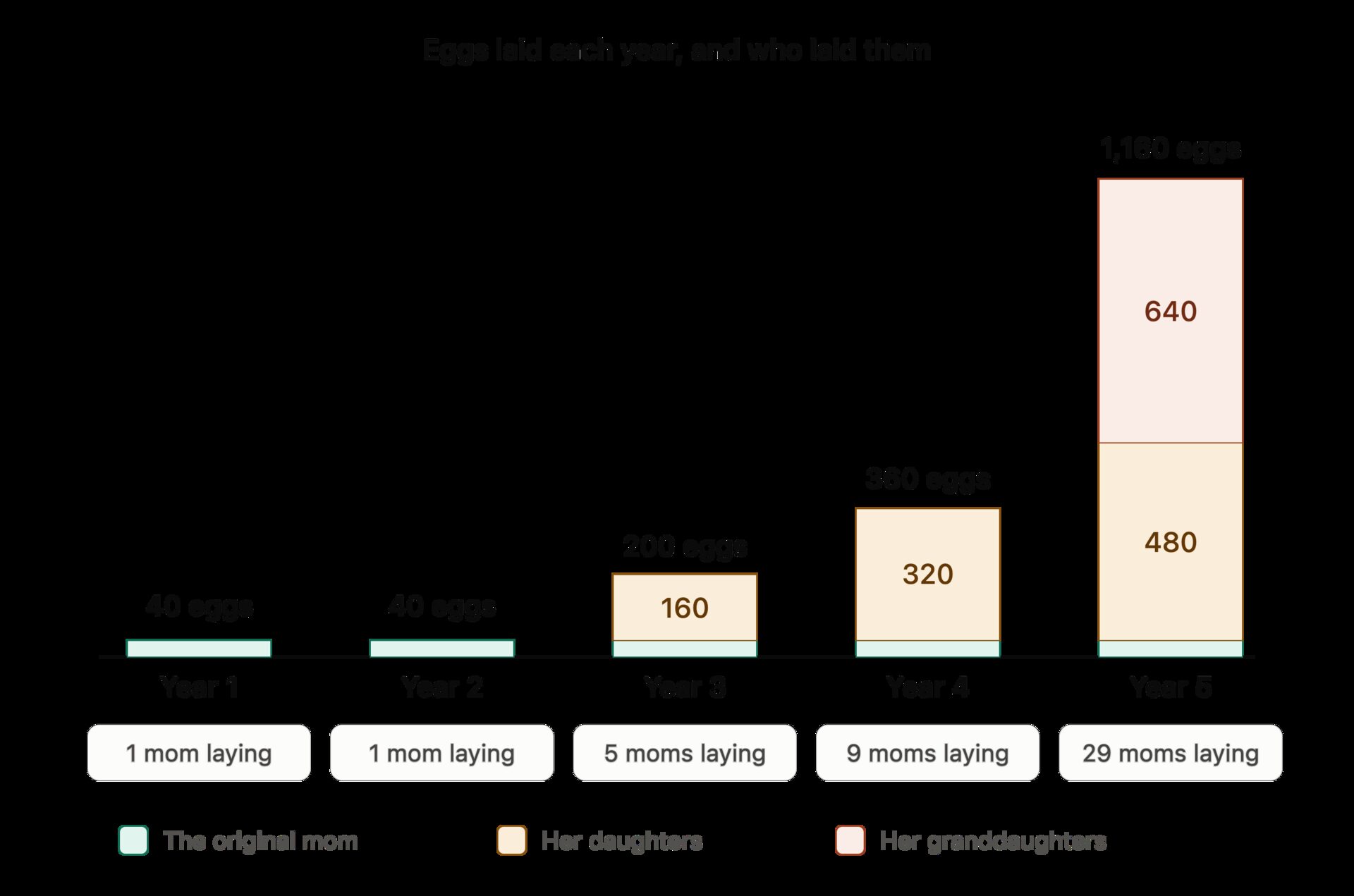
| 5 | 29 | 1,160 | 232 | 116 |
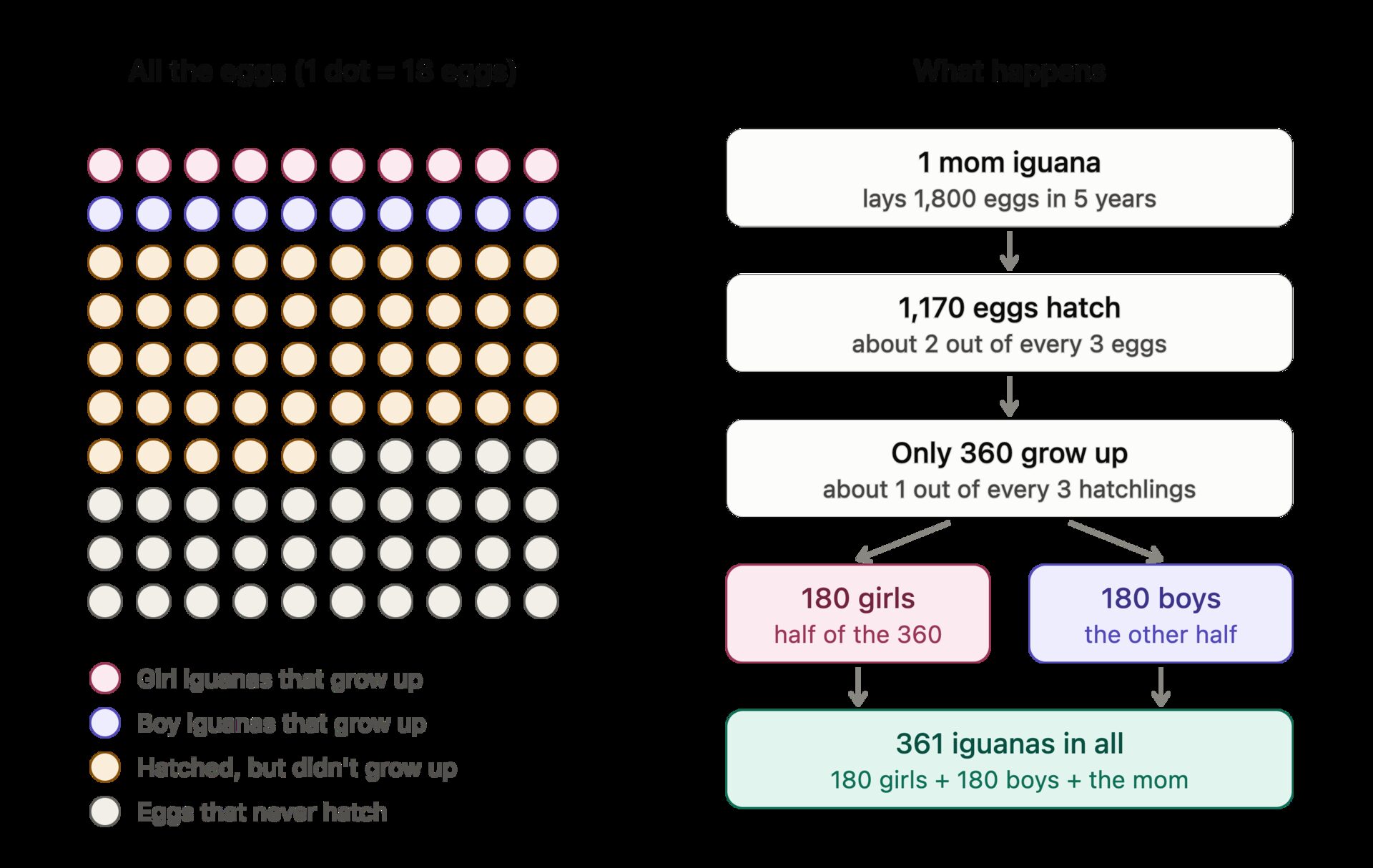
| Total | 29 | 1,800 | 360 | 180 |
With 20% survival, the original female accounts for about 1,800 eggs and 360 expected survivors, half female and half male. Adding the original mother gives roughly 361 iguanas, 181 of them female. Note that the year 4 and year 5 cohorts are still juveniles at the end of year 5, so the 360 figure is an expected total rather than a count of animals already two years old.
Why Year 5 Jumps
The growth comes from each generation of females starting to lay. Of the 1,800 eggs in the 20% scenario, the original mother lays only 200. Her daughters lay 960, and her granddaughters lay 640. By year 5, 29 females are laying, up from one in year 1, and 1,160 eggs are produced in that single year.
How Much Do Results Change With Survival?
Small changes in survival swing the five-year total enormously, because every extra surviving daughter also lays eggs.
| Survival (Egg to Age 2) | Eggs Laid Over 5 Years | Expected Survivors | Females | Males |
|---|---|---|---|---|
| 5% | 480 | 24 | 12 | 12 |
| 10% | 840 | 84 | 42 | 42 |
| 20% | 1,800 | 360 | 180 | 180 |
| 30% | 3,080 | 924 | 462 | 462 |
| 40% | 4,680 | 1,872 | 936 | 936 |
| 100% (theoretical ceiling) | 21,000 | 21,000 | 10,500 | 10,500 |
The original female is not included in the survivor, female, and male columns, so add one female to each total. The 100% row is a mathematical ceiling, not a realistic outcome.
Why Numbers May Run Higher on Golf Courses and in HOA Communities
Published research does not break survival and egg production down by land-use type, so this section is reasoned from the biology rather than measured on golf courses. Several features of managed Southwest Florida landscapes point toward higher numbers than native-range studies report:
- Food is abundant. Green iguanas favor flowers, fruits, and tender shoots. UF/IFAS lists many common ornamentals among their food plants, including hibiscus, roses, orchids, and caladiums. Well-fed females may lay larger clutches and mature earlier.
- Nesting habitat is plentiful. Iguanas dig burrows at the base of seawalls, along canals and levees, and in sunny turf. Lake banks and shoreline edges on golf courses offer the open, sunny, well-drained soil that nesting females look for.
- Few predators of adults. Adults have few predators in Florida other than humans, so the main losses fall on eggs and the smallest juveniles.
- Water everywhere. Iguanas are almost always found near permanent water, and developed communities in Southwest Florida are full of lakes and canals.
Some factors push the other way. Raccoons and foxes still raid nests and take hatchlings in suburban areas, and a hard cold snap can cause serious losses. For that reason, the 30% and 40% rows in the table above should be treated as plausible high-end planning cases for favorable habitat, not as measured values for any specific property.
What This Means for Management
- Breeding females drive growth. Because every surviving daughter becomes a future egg-layer, removing mature females and removing eggs before they hatch has a much larger effect on future numbers than removing males.
- Timing matters. Nesting runs from about December to April, and hatchlings appear in summer. Nest-site management is useful during the nesting season, while trapping can happen year-round.
- Know the rules. Green iguanas are not protected in Florida except by anti-cruelty laws. They can be humanely removed on private property with landowner permission, but captured iguanas cannot be released elsewhere or transported live without a permit. Check with the FWC for current requirements, and consider a licensed professional if you cannot safely or humanely handle removal yourself.
Limitations of These Numbers
This is a simplified model, not a forecast for any particular property. It assumes constant clutch size and survival, no adult mortality after age two, and no immigration or removal. Real populations are shaped by weather, predators, habitat, and active management. Use the scenario table as a way to see how sensitive the outcome is, not as a prediction.
Sources
UF/IFAS Extension (WEC440); Florida Museum of Natural History; Krysko et al. 2007 (Iguana 14:3); Animal Diversity Web, University of Michigan; Arcos-Garcia et al. 2010 (Veterinaria Mexico 41:4); Koomgun et al. 2020 (Frontiers in Genetics 11); Munoz et al. 2003 (Revista de Biologia Tropical 51:1); Nugroho 2020 (Universitas Airlangga thesis); Knapp et al. 2010 (Copeia 2010:1); Perez-Buitrago and Sabat 2007 (Applied Herpetology 4); Knapp and Owens 2008 (Journal of Herpetology); Werner (Green Iguana Management Project); FWC.
Frequently Asked Questions
How many eggs does a female iguana lay per year?
Green iguanas lay between 10 and 70 eggs per clutch, with a typical clutch of around 40 eggs. Females lay one clutch per year in a nest burrow about a foot deep.
How fast can iguanas multiply in Southwest Florida?
In a five-year model at 20% survival from egg to age two, one female iguana and her descendants can account for roughly 1,800 eggs and 360 surviving iguanas. At 40% survival, the total jumps to 4,680 eggs and 1,872 survivors.
When do iguanas nest in Florida?
Iguana nesting season in Florida runs roughly December through April. Eggs incubate for two to four months depending on temperature, and hatchlings emerge in summer.
How old are iguanas when they start breeding?
Female iguanas can reach sexual maturity as early as 24 months in southern Florida. Males can mature as early as 16 months. In the wild, iguanas can live 15 to 20 years.
Why do iguana populations grow so fast on golf courses and in HOA communities?
Golf courses and HOA communities offer abundant food from ornamental landscaping, plentiful nesting habitat in sunny well-drained soil near water, and few natural predators for adults. These conditions can push survival rates higher than in native habitats.
Owner, Rocky's Cane Toad and Iguana Management, LLC - Naples, FL
Chris is a Naples-based wildlife management professional specializing in humane iguana and cane toad removal. Licensed and insured with a Conditional/Prohibited/Nonnative Species Permit from the FWC, he serves homeowners, HOAs, and golf communities across Southwest Florida. Call or text (239) 922-5992.